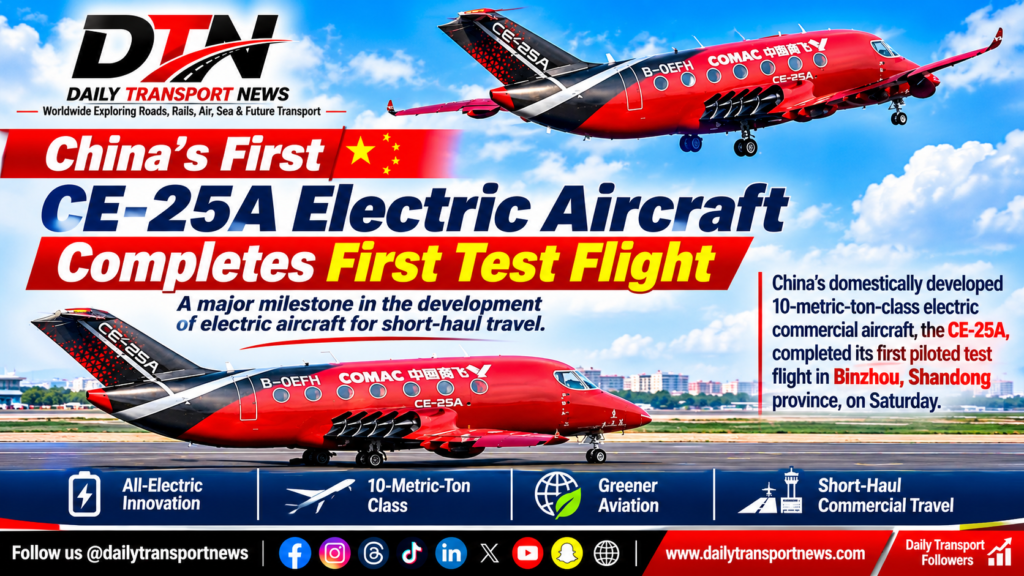
China has achieved a significant milestone in electric aviation after its domestically developed COMAC CE-25A electric commercial aircraft successfully completed its first crewed test flight in Binzhou, Shandong Province, on November 14, 2026.
Developed by the Commercial Aircraft Corporation of China (COMAC), the CE-25A is a 10-tonne-class electric aircraft designed primarily for short-distance commercial passenger transportation between cities.
According to information released through Xinhua, the aircraft carried two pilots and one flight-test engineer during the historic flight. The aircraft performed normally, with its test indicators meeting expectations.
A new chapter in electric commercial aviation
The CE-25A represents an important development in China’s efforts to advance electric-powered commercial aircraft. Unlike conventional aircraft powered by jet engines or turboprops, the CE-25A uses a distributed electric ducted-fan propulsion system installed across its wings.
The aircraft is designed to accommodate up to 19 passengers, making it a potential option for regional and short-haul Air Transportation.
CE-25A key specifications
| Specification | Details |
|---|---|
| Manufacturer | COMAC |
| Aircraft | CE-25A |
| Power | All-electric |
| Maximum take-off weight | 10 tonnes |
| Passenger capacity | 19 passengers |
| Cruising speed | 300 km/h |
| Cruising altitude | 2,400 metres |
| Designed range | 400 km |
| First crewed flight | 14 November 2026 |
| Flight location | Binzhou, Shandong, China |
Developed with major technology partners
COMAC developed the aircraft in collaboration with CATL (Contemporary Amperex Technology Co. Limited), Shanghai Jiao Tong University and other partners.
The aircraft had already completed its first uncrewed autonomous flight on February 2, 2026. COMAC reported that it had conducted 19 uncrewed flight tests before the first crewed flight.
China’s Civil Aviation Administration has also accepted the CE-25A’s type-certificate application, marking another step towards the aircraft’s certification process.
What does this mean for the future of aviation?
Electric aircraft could eventually help reduce reliance on conventional aviation fuels on suitable short-distance routes. The CE-25A’s first crewed flight is an important technological achievement, although further testing, certification and operational validation will be necessary before commercial passenger services can begin.
The aircraft’s 400-kilometre design range also highlights the current focus on regional transportation rather than long-haul aviation.
Daily Transport News perspective
The CE-25A is another important development in the global race to transform aviation through new propulsion technologies. Its future progress will be worth watching as manufacturers explore cleaner and more efficient ways to connect cities.
Source: Xinhua News Agency and COMAC-reported development information. 新华网客户端+1