The future of commercial road transport is becoming increasingly electric, and Ford Trucks F-LINE E represents another step toward cleaner and more sustainable heavy-duty operations.
Designed for demanding transport applications, the F-LINE E combines electric power, high-capacity battery technology and fast charging capabilities with the practicality expected from a modern commercial truck.
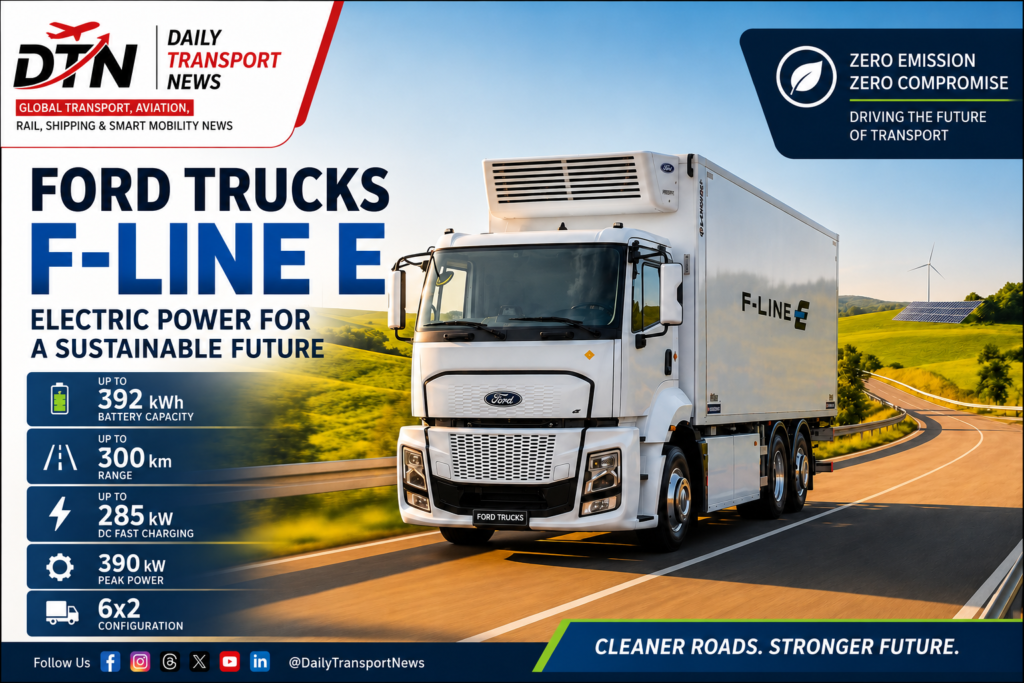
⚡ Up to 392 kWh Battery Capacity
The F-LINE E is equipped with a battery capacity of up to 392 kWh, providing the energy required for demanding transport operations.
A high-capacity battery system can help fleet operators reduce dependence on conventional diesel power while supporting the transition toward lower-emission commercial transportation.
🛣️ Up to 300 km Range
According to the specifications highlighted for the F-LINE E, the electric truck can offer up to 300 km of range.
This makes the vehicle particularly relevant for urban, regional and predictable logistics operations where daily routes can be planned around charging infrastructure.
⚡ Up to 285 kW DC Fast Charging
Charging time is one of the most important considerations for commercial electric vehicles.
The F-LINE E supports up to 285 kW DC fast charging, helping operators minimize vehicle downtime and improve fleet utilization when suitable high-power charging infrastructure is available.
🔋 Up to 390 kW Peak Power
The F-LINE E is also presented with up to 390 kW peak power, highlighting the performance potential of Ford Trucks’ electric platform.
For commercial operators, electric drivetrains can provide strong and immediate torque delivery, an important advantage for stop-start urban operations and demanding road conditions.
🚚 6×2 Configuration
The truck shown in the DTN feature is configured as a 6×2 vehicle.
This configuration is commonly used in road freight applications where operators require a balance between payload capability, maneuverability and operational efficiency.
🌱 Zero Emission. Zero Compromise.
The transition toward electric commercial vehicles is becoming an important part of the global transport industry’s sustainability strategy.
Electric trucks can help reduce tailpipe emissions, particularly in cities and environmentally sensitive operating areas.
For fleet operators, the broader transition also involves charging infrastructure, route planning, energy management and total cost of ownership.
🌍 What Does the F-LINE E Mean for Transport Operators?
Electric trucks are moving beyond passenger vehicles and increasingly entering commercial fleets.
The F-LINE E demonstrates how electric technology can be applied to heavier transport applications while maintaining the core requirements of commercial operators:
- Efficient energy use
- Practical operating range
- Fast charging
- High power output
- Fleet compatibility
- Lower tailpipe emissions
- Sustainable urban logistics
As charging infrastructure continues to develop, electric trucks could play an increasingly important role in the future of freight transportation.
🚛 The Future of Road Freight Is Changing
The commercial vehicle industry is entering a major transformation.
From electric trucks and alternative fuels to connected fleet systems and autonomous technologies, transport companies are looking for solutions that can improve efficiency while reducing environmental impact.
The Ford Trucks F-LINE E is part of this wider transition toward cleaner road freight.
Final Thoughts
With up to 392 kWh battery capacity, up to 300 km range, 285 kW DC fast charging and up to 390 kW peak power, the F-LINE E highlights the growing capabilities of electric heavy-duty vehicles.
For fleet operators planning their transition toward sustainable transport, electric trucks are becoming an increasingly important part of the conversation.
Cleaner roads. Stronger future.