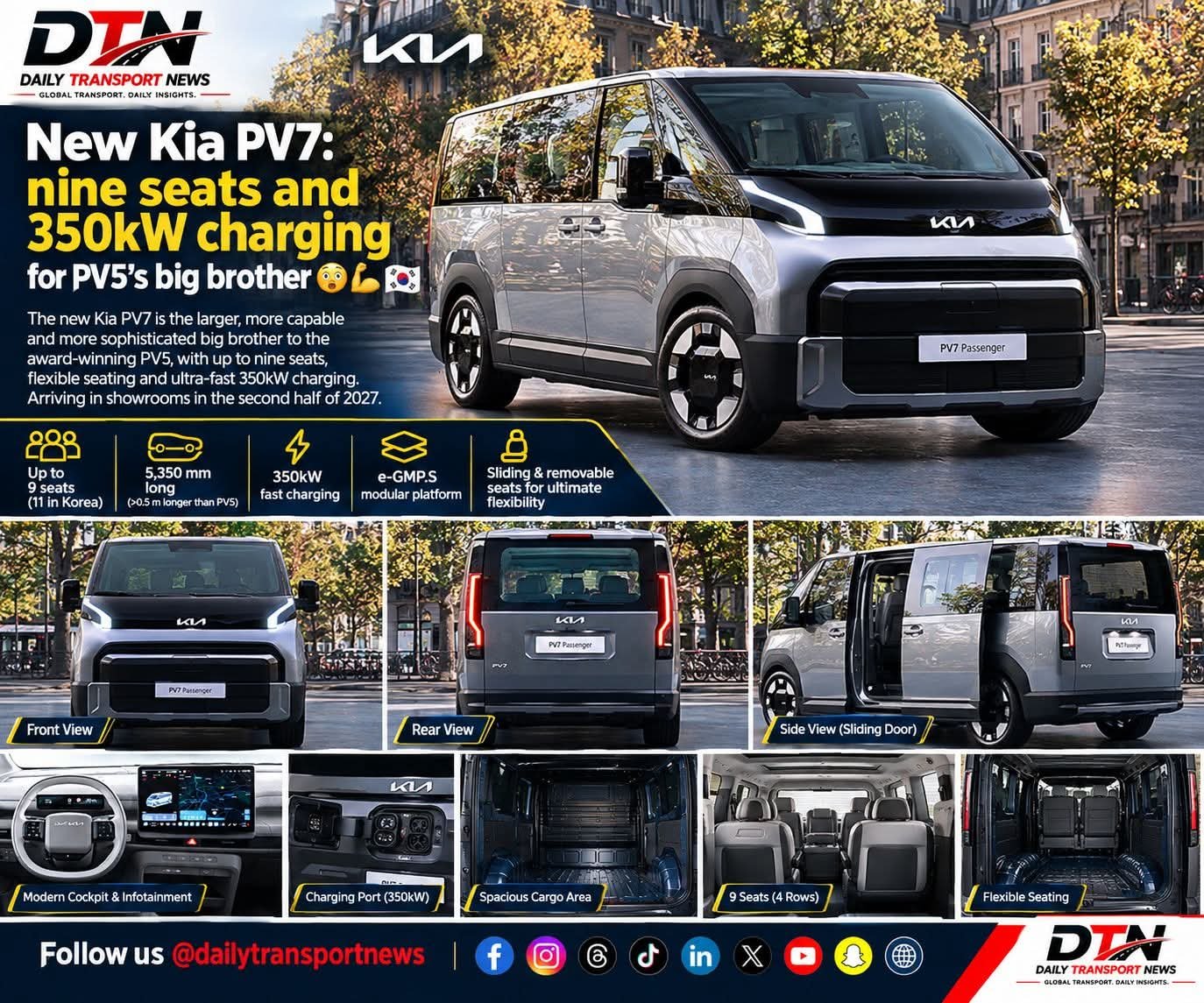
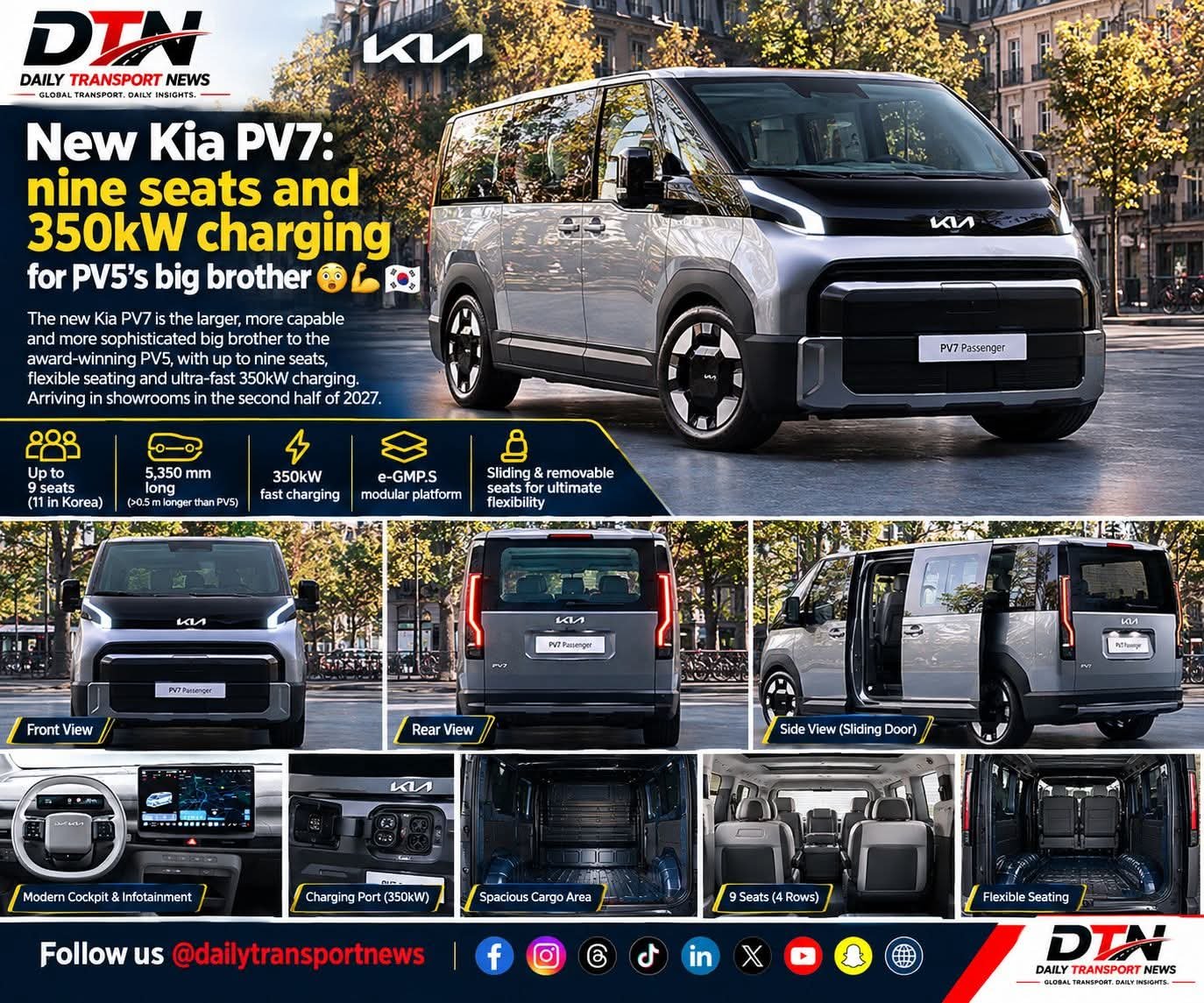
Kia has officially unveiled the new PV7, its larger all-electric PBV.
The model expands the brand’s electric mobility lineup with a passenger van designed for business, family, and commercial transportation.
This is part of the kia-pv7-electric-van-9-seats-350kw-charging family of designs.
Unveiled at IAA Transportation 2026 in Hanover, Germany, the Kia PV7 is the second dedicated model in Kia’s PBV lineup after the PV5. Kia plans to launch the PV7 in Korea and Europe in 2027, with additional derivatives and markets expected to follow. kia-pv7-electric-van-9-seats-350kw-charging
The PV7 is designed to offer considerably more space and flexibility than the smaller PV5. The Passenger version can accommodate up to nine passengers in global markets, while different seating configurations are available depending on the market.
Kia PV7 Offers Flexible Nine-Seat Configuration
One of the biggest highlights of the new Kia PV7 Passenger is its flexible interior.
The global Passenger version can be configured with up to nine seats, with seating arrangements designed around different passenger and transportation requirements.
Kia is also offering flexible seating solutions, including removable and sliding seats on selected configurations. This allows the cabin to be adapted for passenger transportation, family use, shuttle services and other mobility applications.
The vehicle shown at the world premiere features a four-row, nine-seat layout, highlighting the amount of interior space available in the large electric PBV.
5,350mm Long Electric PBV
The Kia PV7 measures approximately:
- Length: 5,350 mm
- Width: 1,995 mm
- Height: 1,990 mm
- Wheelbase: 3,500 mm
Its large dimensions give the PV7 a spacious cabin while allowing Kia to offer both passenger and cargo-focused configurations.
The PV7 is built on Kia’s dedicated E-GMP.S platform, developed specifically for Purpose-Built Vehicles. The platform uses a flexible architecture that supports different body styles and interior configurations.
800V Architecture and 350kW Fast Charging
Charging technology is another major feature of the Kia PV7.
The electric van uses an 800V electrical architecture and supports DC fast charging at up to 350 kW. The battery can be charged from 10% to 80% in roughly the mid-20-minute range when connected to a suitable 350kW DC fast charger.
This capability could make the PV7 particularly useful for commercial fleets, shuttle services and operators that need to minimize charging downtime.
The PV7 also introduces dual charging ports, including a front AC/DC charging port and an optional rear-side AC charging port.
Two Battery Options
Kia has announced two NCM battery options for the PV7:
- 71.5 kWh
- 96.2 kWh
The Long Range Cargo version is expected to offer more than 460 km of range under the WLTP cycle. Kia has not positioned that Cargo figure as the official range figure for the heavier Passenger configuration, so real-world and Passenger-model range will depend on specification, seating configuration and market.
Up to 200kW Electric Power
Depending on market and configuration, the PV7’s electric drivetrain produces up to 200 kW (272 hp) and 420 Nm of torque.
Front-wheel drive will be standard initially, while Kia says an all-wheel-drive version is planned for the future.
This combination gives the PV7 enough performance for both urban transportation and longer-distance commercial operations.
Passenger and Cargo Versions
The Kia PV7 is not simply a large passenger van.
Kia is developing both Passenger and Cargo versions, allowing the platform to serve a variety of applications.
The Cargo model is aimed at businesses including:
- Logistics
- Delivery
- Fleet operations
- Service businesses
- Small and medium-sized enterprises
The Passenger model, meanwhile, is designed for:
- Family transportation
- Shuttle services
- Tourism
- Passenger transport
- Business mobility
Kia’s flexible PBV strategy is intended to allow the same basic platform to support multiple body types and specialized applications.
Smart Technology and Connectivity
The PV7 also moves beyond conventional van technology with Kia’s connected vehicle ecosystem.
The vehicle uses Pleos Connect, based on Android Automotive OS, providing connected navigation, flexible screen layouts, an app marketplace and over-the-air software updates.
Kia is also introducing Gleo AI, an AI-based voice assistant designed to allow drivers to interact with vehicle functions, navigation and communications using natural language.
The PV7 also supports Vehicle-to-Load (V2L) technology, allowing the vehicle’s battery to supply power to external equipment and devices.
Kia PV7 Launch Timeline
The Kia PV7 made its world premiere at IAA Transportation 2026 in Hanover, Germany, on September 14, 2026.
Kia plans to launch the PV7 in Korea and Europe during 2027, beginning with Passenger and Cargo variants. Additional versions and markets are expected to follow.
Kia PV7: A Bigger Step Into Electric Commercial Mobility
The Kia PV7 represents a major expansion of Kia’s Purpose-Built Vehicle strategy.
The PV7 features a 5.35-metre body with flexible seating and up to nine seats. It uses 800V electrical architecture to support high-performance operation. This configuration aims to balance passenger comfort with versatile cargo and crew needs, enabling efficient urban transit and flexible shuttle use.
It supports 350kW DC fast charging and offers multiple battery options, giving operators rapid replenishment and tailored range. This combination is designed to bridge the gap between passenger transport and commercial mobility, enabling fleets to adapt to varying daily requirements while maintaining efficiency and reliability across routes.
Its flexible platform could make it particularly attractive for shuttle operators, tourism companies, fleets, families and businesses looking for a large zero-emission vehicle.
As Kia prepares for the PV7’s 2027 launch, the model will become an important part of the company’s growing electric PBV lineup alongside the PV5.
Key Specifications
| Feature | Kia PV7 |
|---|---|
| Vehicle type | Electric PBV |
| Passenger capacity | Up to 9 seats globally |
| Platform | E-GMP.S |
| Battery options | 71.5 kWh / 96.2 kWh |
| Maximum power | Up to 200 kW |
| Maximum torque | 420 Nm |
| Charging architecture | 800V |
| DC fast charging | Up to 350 kW |
| 10–80% charging | Mid-20-minute range |
| Long Range Cargo range | 460+ km WLTP |
| Length | 5,350 mm |
| Width | 1,995 mm |
| Height | 1,990 mm |
| Wheelbase | 3,500 mm |
| Drive | Front-wheel drive initially |
| Future version | AWD planned |
| Launch | 2027 |
| Initial markets | Korea and Europe |
Specifications may vary by market, body style, battery and final production configuration.